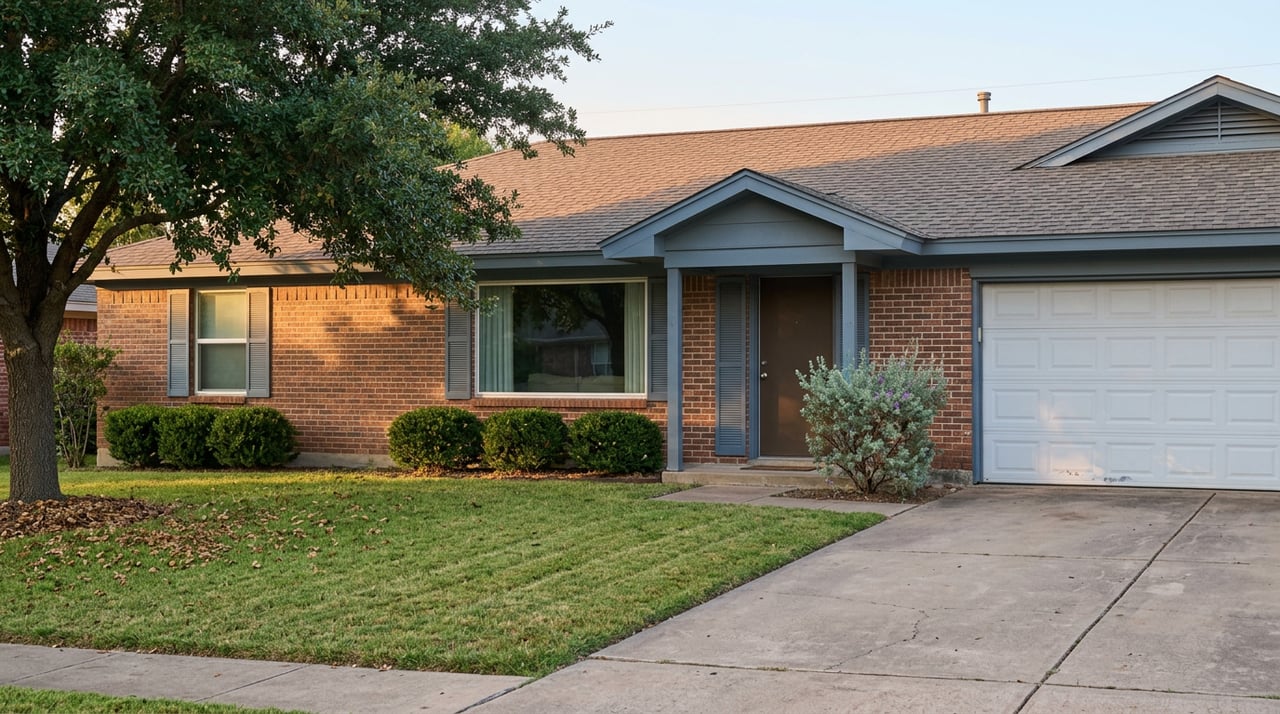
Why does a seller's disclosure form in Burkburnett ask about jet noise from a military base that isn't even inside city limits?
Most sellers skim past that paragraph. It reads like the kind of legal filler that shows up on every Texas form regardless of where the house sits: something about death disclosures, something about HOA fees, something about a military installation that "may" affect the property. Sign here, initial there, move on to the inspection report.
For a meaningful number of parcels near Sheppard Air Force Base, that paragraph isn't filler. It's the visible edge of a zoning structure that can decide whether a new well gets a water tap, whether an addition gets a certificate of occupancy, and how tall a building near the runway is allowed to be. If you're selling, buying, or building in Burkburnett, it's worth knowing what that paragraph is actually pointing to.
The Paragraph Nobody Reads Twice
Every Texas seller's disclosure notice built on the current Texas Real Estate Commission form includes language stating that a property may be located near a military installation and "may be affected by high noise or air installation compatible use zones." The form directs both buyer and seller to the most recent Air Installation Compatible Use Zone, or AICUZ, study for the relevant base, and to the county and municipal websites where that study lives. It's on the version of the form used for contracts signed on or after September 1, 2023, and it's on every disclosure regardless of whether the specific house is anywhere near a flight path.
The current TREC disclosure notice is where that language lives today. What most people don't ask is where the requirement itself came from, or why it matters more in some Burkburnett neighborhoods than in others.
A Wichita Falls State Senator Wrote the Rule That Follows You to Closing
The military disclosure paragraph was added to Texas Property Code Section 5.008 effective September 1, 2017. Texas REALTORS credited the bill to then-state Senator Craig Estes, whose district included Wichita Falls, and described its purpose plainly: give buyers a heads-up about potential aircraft noise and installation activity without putting the burden on sellers to go investigate whether that disclosure applies to their specific address.
That's a reasonable trade for the state to make. It also means the paragraph on your Burkburnett listing exists because of a law written with this exact base in mind, not a generic template imported from somewhere else in Texas.
Why Burkburnett Specifically Is on the Hook
Sheppard AFB sits about five miles north of downtown Wichita Falls, with the base's western and southern portions inside Wichita Falls city limits and the rest in unincorporated Wichita County, according to a Department of Justice brief filed in Cox v. United States, a federal case brought by property owners near the base challenging the resulting zoning ordinance. That same court record documents something specific to this market: the Air Force's 1992 AICUZ study for Sheppard recommended that local planning agencies incorporate AICUZ policies into the comprehensive plans of "the Cities of Wichita Falls and Burkburnett, and Wichita County."
Burkburnett isn't a bystander here. It was named directly in the federal planning study that still governs how land near Sheppard gets used, and the federal court upheld the resulting zoning approach as a legitimate use of police power meant to protect both the people living near the airfield and the base's ability to keep operating.
Burkburnett has its own comprehensive zoning ordinance, adopted as Ordinance #589 in April 2000 under the authority of Texas Local Government Code Chapter 211, and the city keeps that ordinance and its zoning map active. City commission minutes from June 2025 show the Board of Commissioners amending the zoning classification on a parcel under the same comprehensive ordinance, which means this isn't a dusty rule from three decades ago. It's a document the city government is still actively applying.
What the Zone Actually Controls
Wichita Falls' own municipal code, which sits alongside Burkburnett's under the same underlying AICUZ study, spells out exactly what these zones mean in practice. The dimensions vary by runway, which is the kind of detail that turns an abstract disclosure into a concrete boundary on a map:
| Zone type | Runway 17/35 | Runways 15R/C/L and 33L/C/R |
|---|---|---|
| Accident Potential Zone I | 1,000 ft wide, 2,500 ft long | 3,000 ft wide, 5,000 ft long |
| Accident Potential Zone II | 1,000 ft wide, 2,500 ft long | 3,000 ft wide, 7,000 ft long |
| Clear Zone (Zone B) | 1,000 ft wide, 3,000 ft long | 3,000 ft wide, 3,000 ft long |
| Primary Zone (Zone A) width | 1,000 ft | 2,000 ft |
Noise zones are drawn separately, based on the 65-decibel day-night average sound level contour mapped in the AICUZ study. Anything inside that 65 dB line, or inside an Accident Potential Zone, falls under a compatible-use table that limits what can be built and how.
You can read the full text of Wichita Falls' zoning provisions for Sheppard AFB directly. Burkburnett's parcels sit under the same federal study, which is why the city was named in the 1992 planning directive in the first place, but the parcel-by-parcel zone lines for property inside Burkburnett's own jurisdiction are something the city's building official or development services office confirms, not something a seller should assume from a Wichita Falls map.
The Part That Surprises People at the Building Department
Here's the mechanism that actually catches people off guard, and it has nothing to do with how loud a jet sounds on a Tuesday afternoon.
Inside the 65 dB noise contour, a permit is required for any use or structure the compatibility table flags as needing noise attenuation. That permit doesn't get issued until a building official signs off on the attenuation measures. For commercial property, no certificate of occupancy is granted until that compliance inspection is complete. For residential construction that requires attenuation, the ordinance goes a step further: no water sales by the city or the applicable water district are permitted until compliance is verified.
Read that again. In the zones where it applies, this isn't a disclosure that a buyer might find mildly annoying. It's a gate on the water tap itself, tied to an inspection that has to happen before the county or the supply corporation will turn the water on for a new hookup.
That's the piece worth understanding before you write a contract on new construction, a rebuild, or a major addition on a parcel close to the base. It's also the reason this disclosure paragraph deserves more attention than the average line item on a Texas form.
What This Means If You're Selling or Building in Burkburnett
If you already own a home with existing water service and you're not doing new construction, the attenuation and water-hookup mechanics generally aren't something you'll run into at resale. The disclosure paragraph still has to appear on the form, and it's worth completing honestly based on what you know, but it isn't going to stall your closing.
If you're building new, replacing a water line, adding square footage that requires a fresh permit, or buying vacant land near the base with plans to build, the order of operations matters. Confirm the parcel's zone classification with the city before you're under contract, not after. A noise attenuation requirement discovered during a permit application is a very different timeline than one confirmed during due diligence.
Sellers of larger acreage or land parcels near the flight paths should also know that the AICUZ compatible-use tables restrict certain land uses outright in the highest-impact zones, which can affect what a buyer is realistically planning to do with the property.
A Few Questions Worth Asking
Does every home in Burkburnett need this disclosure? Every Texas seller's disclosure form built on the current TREC template includes the paragraph, regardless of the address. Whether the AICUZ zoning mechanics described above actually apply to a given parcel depends on where that parcel falls relative to Sheppard's runways and noise contours.
Does this affect existing homes with water service already connected? The water-hookup restriction in the ordinance is tied to new construction requiring attenuation compliance, not to homes that already have an active water connection.
Where do I find the zone for my specific property? The disclosure form itself directs buyers and sellers to the AICUZ study and to the county and municipal websites for the jurisdiction where the property sits. For a Burkburnett parcel, that means checking with the city's development services office directly, since Burkburnett's zoning ordinance, not Wichita Falls', is what governs permits inside Burkburnett's limits.
If you're getting ready to list a property near Sheppard, or you're eyeing a parcel for new construction and want to know what zone it falls in before you write an offer, call Williams Realty and Auction to walk through what that paragraph on your disclosure actually means for your specific address.